

The Monetization Gap Reshaping the Rights Economy
The global rights economy is growing, but not for everyone, and for rights holders outside the top tier, that reality matters more than ever.
Value is concentrated at the very top. Buyers - streamers and broadcasters - are consolidating. And across the rest of the market, the ability to monetize content is no longer keeping pace with demand. The result is a widening monetization gap that prevents revenue growth and audience access.
The Monetization Gap Is Real, and it's Structural
This isn't a cyclical downturn. It's a structural shift. Across all premium content - such as live sport, music and entertainment - three forces are converging.
1. Value is concentrating
A small number of premium properties are absorbing a disproportionate share of rights spend, leaving mid-tier and niche content competing for a shrinking slice of the market.
2. The buyer pool is shrinking
Broadcaster consolidation and changing economics mean fewer guaranteed deals and fewer long-term licensing opportunities. Every merger removes another potential buyer from the non-top-5 market. The pool shrinks every cycle. The cavalry isn’t coming.
3. Content supply is accelerating faster than monetization can support
The volume of content across sports, entertainment and media is growing exponentially, while advertising and sponsorship budgets are not.
Figure 1. Content Supply is outpacing Monetization
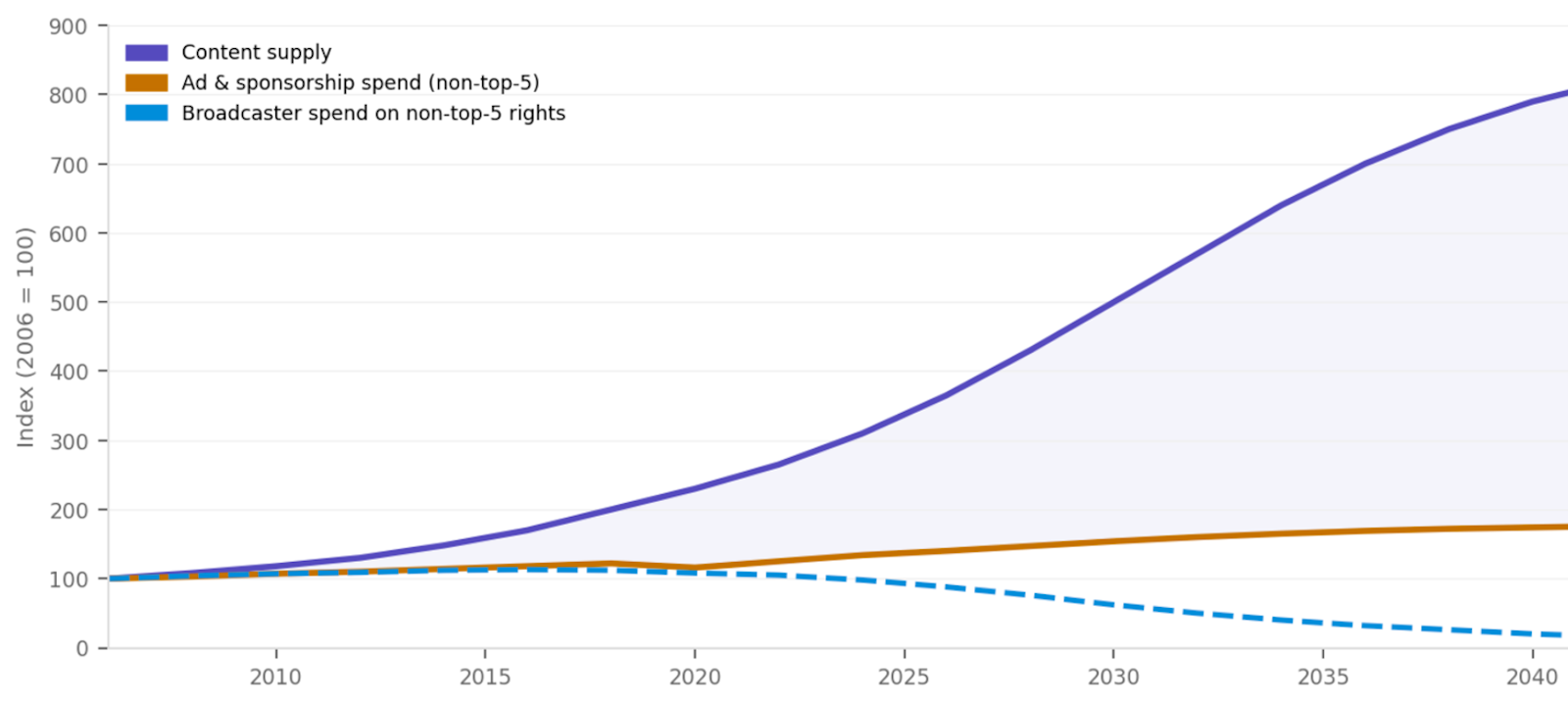
Supply continues to rise sharply while monetization grows far more slowly - and broadcaster spend on non-top-5 rights is in active decline. That gap represents revenue that must be captured somewhere for the system to sustain itself.
Figure 2. Value Is Concentrating at the Top. The Rest of the Market Is Structurally Underserved
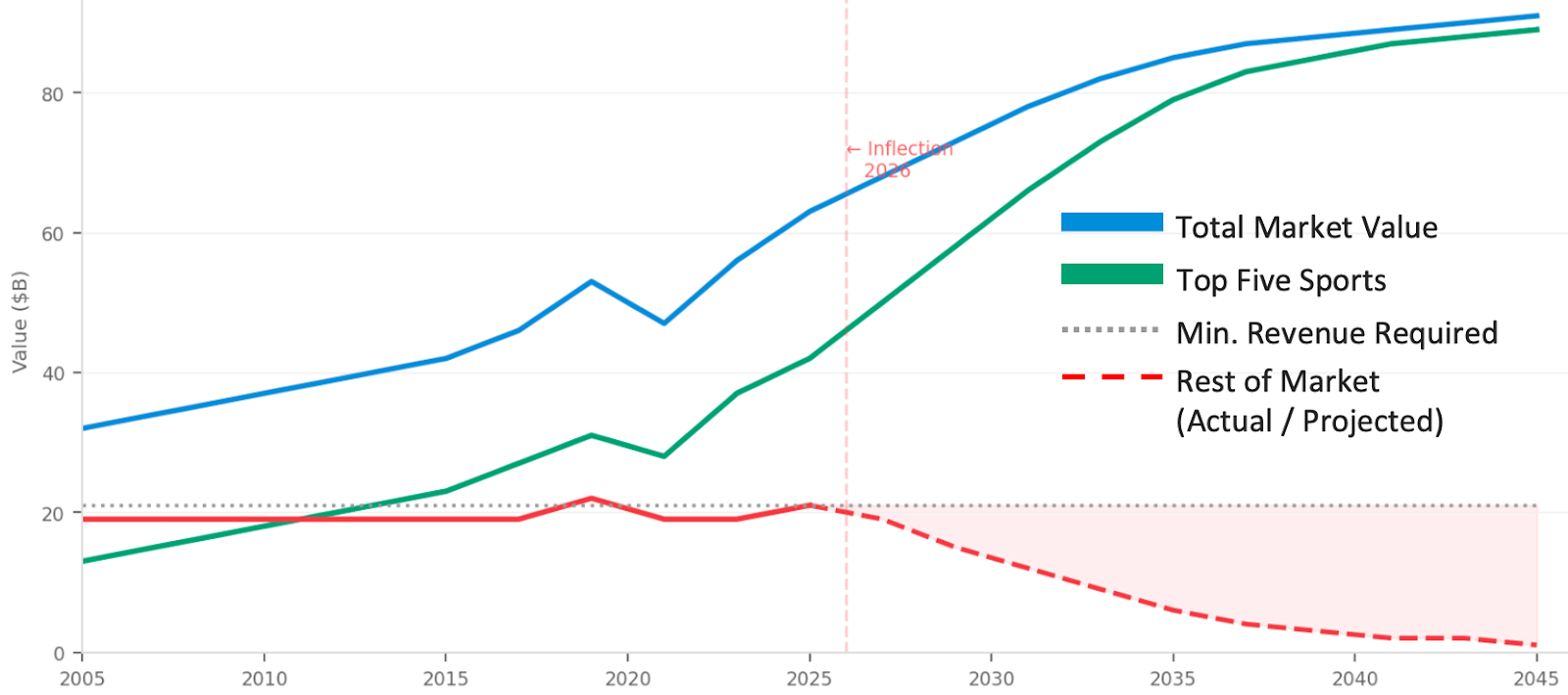
The grey dotted line is not a forecast. It is the minimum revenue rights owners outside the top five need to remain viable - flat real terms, no growth assumed. The gap between that line and where revenue is actually heading represents a ~$10B annual shortfall by 2030. In the current model, that revenue has no mechanism to be captured.
The Industry Has Already Shifted. The Model Hasn't.
Historically, distribution was centralized. Rights flowed through broadcasters and platforms that aggregated audiences and monetized them through ads and subscriptions.
That world no longer exists.
Figure 3. The Shift from Centralized to Distributed Consumption
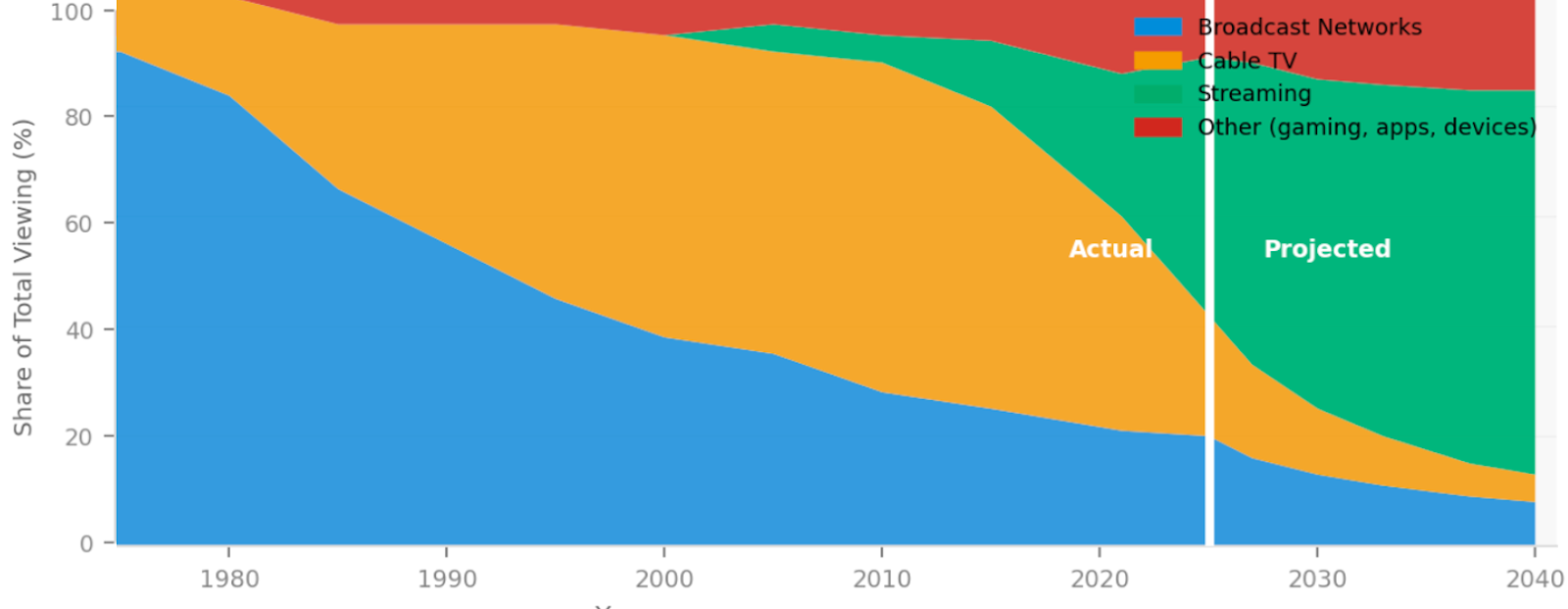
Where broadcast once dominated distribution, today audiences are fragmented across social platforms, publisher sites, apps and communities. Discovery is now decentralized. The industry has effectively turned inside out - content is discovered everywhere, but access still sits behind destinations.
Why Existing Models Alone Aren't Enough
So if the broadcaster buyer pool is shrinking every cycle, the logical response is to build audiences and monetize through advertising. Go to YouTube, grow reach, attract sponsorship, wait for the revenue to follow.
The data says it won't.
The $36B YouTube ad pool is shared across tens of millions of creators. As content supply explodes, CPMs on non-premium content fall. Sponsorship follows the same logic - it concentrates around premium, high-reach properties. The pool gets more diluted as supply increases. And as AI accelerates content production, the supply curve gets steeper. There is no future built on eyeballs. The maths gets worse over time, not better.
Subscriptions offer predictability, but introduce their own limitations. Consumers are becoming more selective, balancing cost, value and flexibility. For rights holders without mass-market scale, subscription alone limits reach and suppresses potential revenue.
In a fragmented ecosystem, both approaches leave value on the table. Free distribution captures attention, but not demand in the moment. Paywalls capture value, but limit reach. This isn't about replacing one model with another. It's about building a more complete monetization stack.
This is where the current model breaks down.
Audiences discover content in real time, across various surfaces. But when they encounter something they want to watch, at that exact moment they are forced to switch platform, commit to a subscription, or abandon the interaction entirely.
This is the monetization gap. It is not a lack of demand. It is a failure to capture demand in the moment it exists.
A New Layer in the Monetization Stack
What's emerging is not a replacement for advertising or subscriptions, but a necessary extension of them. A model where access can be unlocked instantly at the point of discovery, value is exchanged in real time, and distribution and monetization are no longer separate steps.
This transition is not hypothetical. World Supercross generated over $500K in a single week from ~23,000 fans across 70 countries, with minimal marketing spend and no traditional broadcast deal. The demand existed, and finally, there was a mechanism to convert it into value.
In this model:
- Rights holders retain control over pricing, access and distribution
- Publishers and partners become extensions of reach, not gatekeepers
- Audiences gain flexible, instant, on-demand access
- Value flows more directly and efficiently across the ecosystem, in real time
This reframes how monetization works across the entire ecosystem:
- Advertising monetizes reach
- Subscriptions monetize loyalty
- Transactional access monetizes intent
Each serves a different role. Together, they form a complete system.
The Gap Is the Revenue Opportunity
The monetization gap in the rights economy is not a temporary imbalance. It's the result of structural shifts across supply, demand, behaviour and distribution.
But it also represents one of the biggest opportunities in the market.
By combining existing models with new forms of transactional access - and by aligning distribution with how audiences discover content - rights holders of any size and category (sports, music, film, comedy, live events) can unlock new revenue streams without disrupting what already works.
The future of the rights economy won't be defined by a single model. It will be defined by how well the industry connects access, intent, and value, wherever content is discovered.
